Solana Playground
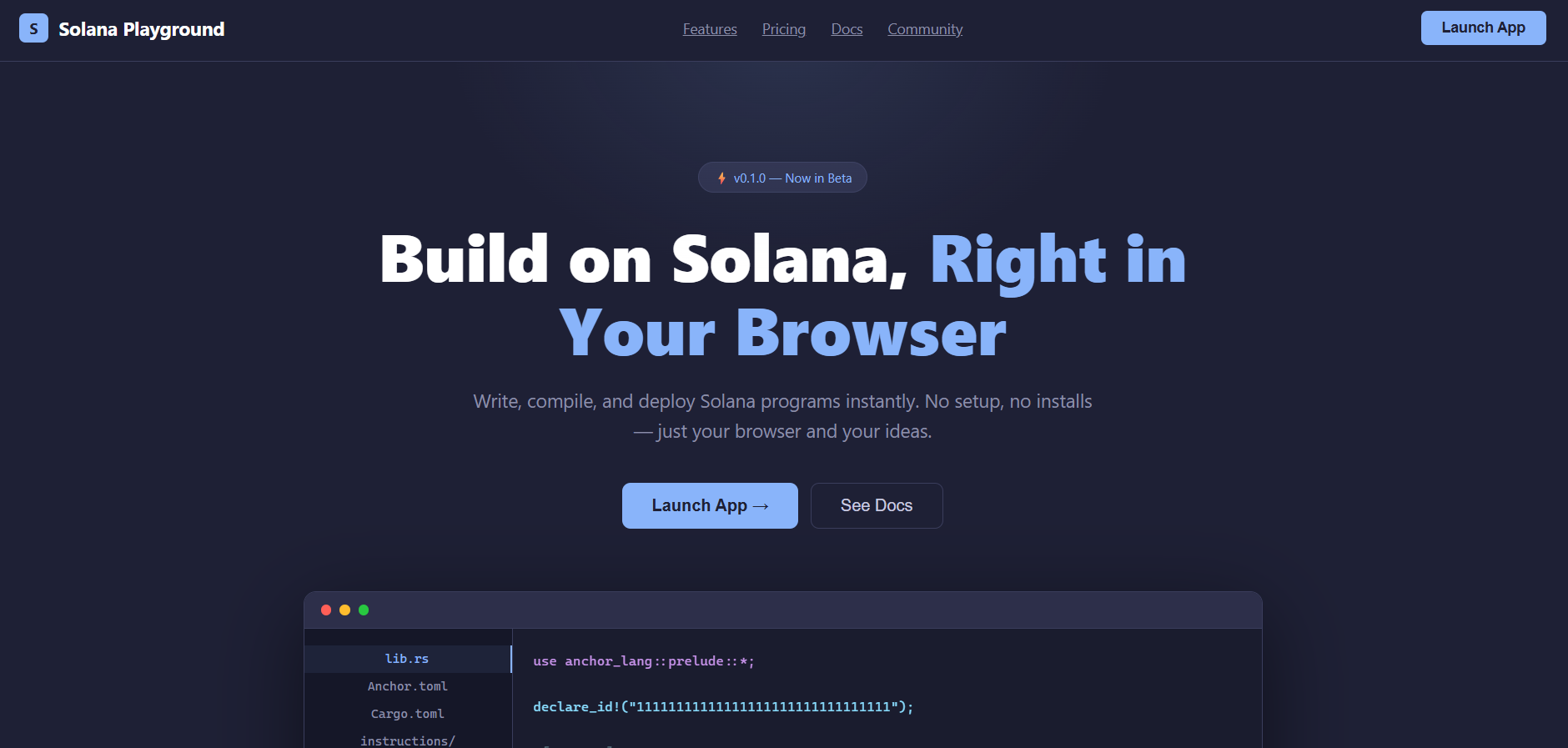
A browser-based IDE for writing, compiling, and deploying Solana Anchor programs — no local toolchain required.
Why I Built It
Learning Solana development has a steep barrier to entry. Before you can write your first program, you need to install Rust, the Solana CLI, Anchor, set up a local validator, configure your IDE, and figure out devnet faucets. That's five steps before writing a single line of code.
Solana Playground removes all of it. You write Rust in a Monaco editor, click "Build", and get a compiled SBF program — all from your browser.
Tech Stack
Frontend
| Layer | Technology | Version |
|---|---|---|
| UI Framework | React | 18.3 |
| Build Tool | Vite | 5.4 |
| Language | TypeScript | 5.5 |
| Editor | Monaco Editor (@monaco-editor/react) | 4.6 |
| Web3 Client | @solana/web3.js | 2.0 |
| Hosting | Vercel | — |
Backend (Compiler Service)
| Layer | Technology | Version |
|---|---|---|
| Runtime | Node.js | 20 (Docker) |
| Framework | Express | 4.19 |
| Solana CLI | solana-cli | 1.18.18 |
| Anchor | avm + anchor-cli | 0.30.1 |
| Rust (build) | rustc | 1.85.1 |
| Rust (runtime) | rustc | 1.75.0 |
| platform-tools | SBF toolchain | v1.41 |
| Web3 Client | @solana/web3.js | 1.0 |
| Hosting | Railway (Docker) | — |
Shared Packages (npm Workspaces)
| Package | Role |
|---|---|
| @solshift/core | Types, constants, cluster config, wallet encryption utilities |
| @solshift/engine | CompilerClient — HTTP client for all build service endpoints |
| @solshift/shell | TerminalEmulator — interprets solana + anchor CLI commands in-browser |
| @solshift/plugin-manager | ProjectManager — scaffold, CRUD, localStorage persistence |
| @solshift/integrations | IDL client generator, PDA derivation, Borsh serialization |
System Design — Architecture Overview
┌─────────────────────────────────────────────────────────────┐
│ Browser (Vercel CDN)                                        │
│  ┌───────────────────────────────────────────────────────┐  │
│  │ React SPA (Vite)                                      │  │
│  │  ┌──────────┐ ┌──────────┐ ┌────────┐ ┌───────────┐ │  │
│  │  │  Monaco  │ │ Terminal │ │ Wallet │ │ Build/    │ │  │
│  │  │  Editor  │ │ Emulator │ │ Panel  │ │ Deploy UI │ │  │
│  │  └────┬─────┘ └────┬─────┘ └────────┘ └─────┬─────┘ │  │
│  │       └────────────┴──────────┬──────────────┘       │  │
│  │                        ┌──────┴──────┐               │  │
│  │                        │ Compiler    │               │  │
│  │                        │ Client      │               │  │
│  │                        └──────┬──────┘               │  │
│  └───────────────────────────────┼───────────────────────┘  │
│                                  │ HTTP (fetch)              │
└──────────────────────────────────┼───────────────────────────┘
                                   ▼
┌─────────────────────────────────────────────────────────────┐
│ Railway (Docker Container)                                  │
│  ┌───────────────────────────────────────────────────────┐  │
│  │ Express Server                                         │  │
│  │  POST /api/build    → buildService.ts → cargo build-sbf│  │
│  │  POST /api/deploy   → solana program deploy            │  │
│  │  POST /api/simulate → balance + rent + conflict check  │  │
│  │  POST /api/debug-cpi→ CPI log parser / local validator │  │
│  │  POST /api/profile  → local validator + simulate + CU  │  │
│  │  POST /api/airdrop  → faucet → RPC pool → fallback    │  │
│  │  GET  /api/balance  → solana balance                   │  │
│  └──────────────────────┬────────────────────────────────┘  │
│                         │                                    │
│  ┌──────────────────────▼────────────────────────────────┐  │
│  │ Docker Image (rust:1.75-slim-bookworm)                 │  │
│  │  ┌──────────┐ ┌──────────┐ ┌──────────┐ ┌─────────┐ │  │
│  │  │ Solana   │ │ Anchor   │ │ Rust     │ │platform-│ │  │
│  │  │ CLI 1.18 │ │ 0.30.1   │ │ 1.85     │ │tools    │ │  │
│  │  └──────────┘ └──────────┘ └──────────┘ └─────────┘ │  │
│  └──────────────────────────────────────────────────────┘  │
└──────────────────────────┬──────────────────────────────────┘
                           │
                           ▼
              ┌────────────────────────┐
              │ Solana Devnet / Testnet│
              │ (RPC API)              │
              └────────────────────────┘
Frontend — Component Tree & State Management
The frontend manages all state in a single App component using React hooks (useState, useCallback, useRef, useEffect). No external state library — the application's state surface is small enough that prop drilling and callback passing suffice.
App
├── LandingPage (marketing site, toggled via showLanding boolean)
└── Playground
    ├── Toolbar
    │   ├── Cluster selector (devnet/testnet/mainnet)
    │   ├── Build button
    │   ├── Deploy button
    │   └── API status dot
    ├── Icon Sidebar (files | search | docs | settings)
    ├── Side Panel
    │   ├── FileExplorer (file tree + project files)
    │   ├── WalletPanel (generate, import, connect browser wallet, airdrop)
    │   └── DocsPanel (faucet docs, funding instructions)
    ├── EditorPanel (Monaco editor, language-aware)
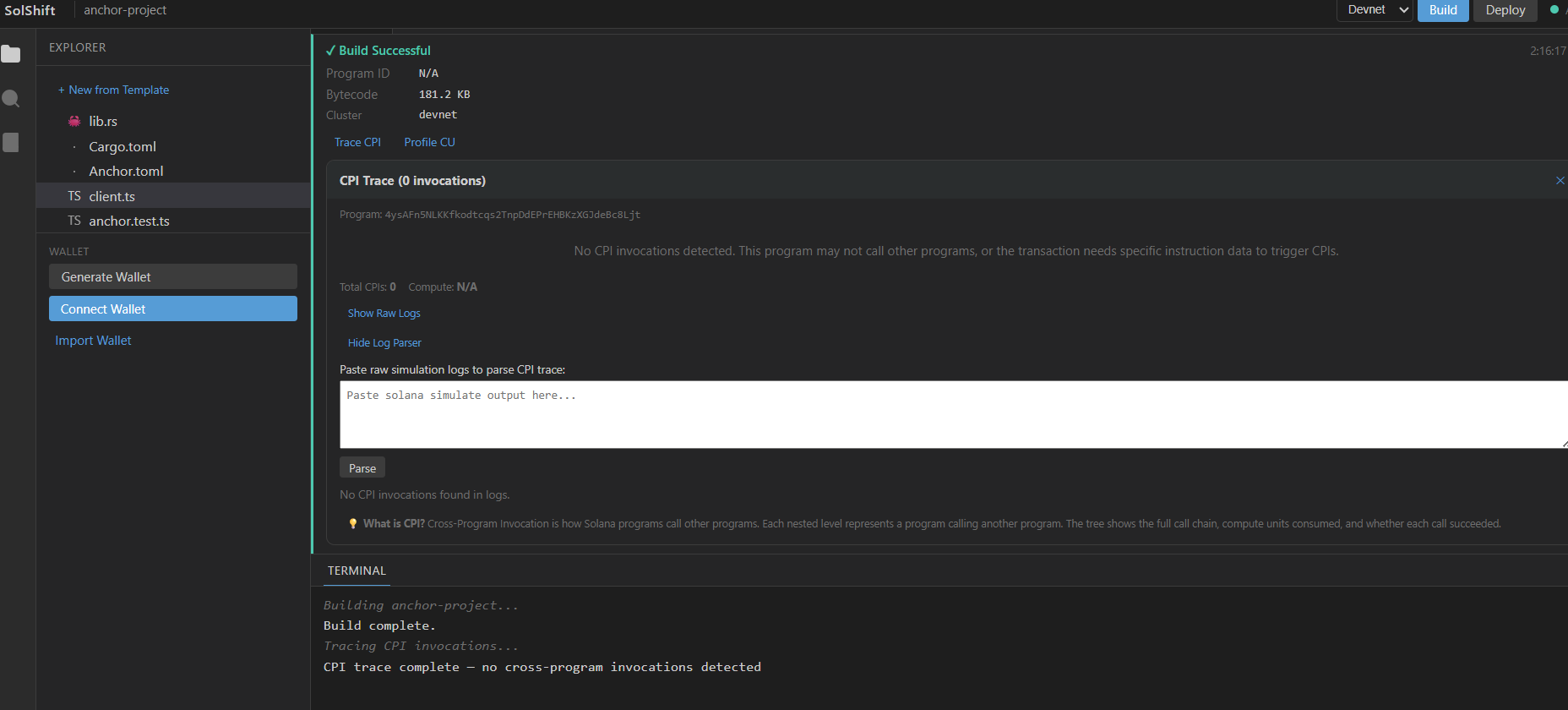
    ├── BuildResult (build output + simulate + deploy + CPI + Profile CU)
    └── TerminalPanel (command input + scrollable output)
Key State
interface AppState {
  project: SolpgProject | null         // Current project + files
  activeFile: SolpgFile | null         // Currently open in editor
  wallet: WalletState | null           // publicKey + secretKey + connected
  balance: number | null               // Devnet SOL balance
  builtBytecode: string | null         // Compiled .so (base64)
  builtKeypair: string | undefined     // Program keypair (base64)
  buildResult: BuildResultData | null  // Build output info
  terminalLines: TerminalLine[]        // Terminal history
  isBuilding / isAirdropping / isSimulating / isProfiling
  apiConnected: boolean | undefined
  activeSidebar: 'files' | 'search' | 'docs' | 'settings' | ''
  cluster: 'devnet' | 'testnet' | 'mainnet-beta'
  profileData / cpiData / simulation   // Analysis results
}
Backend — Express Request Lifecycle
Each API request follows the same pattern:
- Validation — Check required fields, keypair byte lengths, file constraints
- Scaffolding — Create a UUID-temp directory under
/tmp - Execution — Run the relevant CLI command (
cargo build-sbf,solana program deploy, etc.) viaexecSyncwith timeouts - Cleanup — Remove temp directory in
finallyblock - Response — Return JSON with success/error and relevant data
The server has a concurrency limit (activeBuilds counter) — max 2 concurrent builds. Requests exceeding this get a 429 "build queue full" response.
Storage & Data Persistence (No Traditional Database)
There is no database — no PostgreSQL, no Redis, no MongoDB. The architecture deliberately avoids persistent storage for simplicity and cost. Data lives in three places:
1. Browser localStorage
| Key | Content | Encrypted? |
|---|---|---|
| solpg_wallet | JSON-serialized WalletState (publicKey + secretKey + connected flag) | ✅ XOR cipher with session-derived key |
| solpg_projects | JSON array of SolpgProject (files + metadata) | No (no sensitive data) |
| solpg_cluster | Cluster name string ('devnet' | 'testnet' | 'mainnet-beta') | No |
2. Browser sessionStorage
| Key | Content | Why sessionStorage? |
|---|---|---|
| solpg_enc_key | 32-byte random XOR key (hex-encoded) | Cleared on tab close — wallet cipher key never persists |
3. /tmp on the Docker Container
Each API request creates a UUID-named directory under /tmp for temporary files (keypairs, program binaries, Anchor project scaffolding). These are cleaned up in the finally block of every request handler.
Wallet Encryption Scheme
// On tab open: generate 32 random bytes → store in sessionStorage
// On wallet save:
//   1. JSON.stringify({ publicKey, secretKey, connected })
//   2. XOR each byte of the JSON string with key[i % 32]
//   3. Hex-encode the XOR'd bytes
//   4. Store in localStorage as 'solpg_wallet'
//
// On wallet load: reverse the process
// On tab close: sessionStorage is wiped → key is lost → ciphertext is useless
//
// This ensures secret keys never persist in localStorage as plaintext
// after the browser tab is closed.
API Design — Endpoint Details
POST /api/build — The Core Pipeline
Request:  { programName: string, files: { path: string, content: string }[] }
Response: { success: boolean, program?: string (base64 .so), programId?: string,
            programKeypair?: string (base64), error?: string, logs?: string }

Flow:
  1. Validate programName (lowercase snake_case, 2-64 chars) and files (max 40, max 200KB each)
  2. Scaffold project skeleton under /tmp/{uuid}:
     - programs/{name}/src/  ← user's .rs files
     - programs/{name}/Cargo.toml  ← auto-generated with anchor-lang dep
     - Anchor.toml
     - Cargo.toml (workspace)
  3. Copy pre-built Cargo.lock (cached from Docker build) for faster dependency resolution
  4. Run `cargo generate-lockfile --offline`
  5. Downgrade lockfile v4 → v3 (compatibility)
  6. Run `CARGO_TARGET_DIR=... cargo build-sbf --offline`
  7. Read artifacts from shared CARGO_TARGET_DIR:
     - {name}.so → base64 encode
     - {name}-keypair.json → base64 encode + derive programId via solana-keygen
  8. Clean up temp dir
  9. Return result

Validation:
  - programName must match /^[a-z][a-z0-9_-]{1,63}$/
  - File paths must be relative, no '..' traversal
  - Max 40 files, max 200KB per file
  - Timeout: 300 seconds (cargo build can be slow on cold starts)
POST /api/deploy
Request:  { bytecodeBase64: string, authoritySecretKey: string (hex 64 bytes),
            programKeypair?: string (base64), cluster?: string }
Response: { signature?: string, programId?: string, error?: string }

Flow:
  1. Decode + validate authoritySecretKey (must be exactly 64 bytes)
  2. Write authority keypair JSON + program binary to /tmp
  3. If programKeypair provided: write it → deterministic program ID
  4. Run: solana program deploy --chunk-size 65536 --url {cluster}
  5. Parse "Program Id: <address>" from output
  6. Return transaction output + program ID

Security:
  - The authority's secret key is transmitted to the backend (hex-encoded over HTTPS)
  - Browser wallets (Phantom) now supported via temp keypair generation + airdrop funding
POST /api/airdrop — Multi-Tier Fallback
Request:  { address: string, amount?: number, cluster?: string }
Response: { signature?: string, error?: string }

Tier 1 — Faucet Transfer (instant, no rate limits):
  IF FAUCET_SECRET_KEY is set and has SOL:
    solana transfer --keypair faucet.json {address} {amount}
  ELSE fall through

Tier 2 — RPC Airdrop Pool (25s deadline):
  For each RPC in shuffled pool [DEVNET_RPC_URL, api.devnet.solana.com, helius]:
    Approach A: solana airdrop {amount} {address} --url {rpc} (20s timeout)
    Approach B: Connection.requestAirdrop(pubkey, lamports) (15s timeout)
    Break on first success

Tier 3 — Client-Side Fallback (user's browser IP):
  Frontend retries requestAirdrop from user's browser
  (separate rate-limit pool from Railway's IP)

Error handling:
  Returns actionable message with faucet funding instructions on total failure
POST /api/profile — CU Profiler
Request:  { bytecodeBase64: string, authoritySecretKey: string (hex 64 bytes),
            programKeypair?: string, instructionData?: string (base64) }
Response: { success: boolean, totalCuConsumed: number, cuCap: number,
            cuUtilization: number, programId: string,
            instructions: CpuProfileNode[], error?: string, logs: string[] }

CpuProfileNode:
  { programId: string, cuConsumed: number, ownCu: number,
    depth: number, success: boolean, error?: string,
    percentage: number, isHotspot: boolean (>20% of total),
    children: CpuProfileNode[] }

Flow:
  1. Write program + keypairs to /tmp
  2. Start solana-test-validator (local, ephemeral)
  3. Deploy program to local validator
  4. Construct Transaction with program instruction
  5. simulateTransaction({ innerInstructions: true, sigVerify: false })
  6. Parse logs with regex stack-based parser:
     - /Program (\w+) invoke \[(\d+)\]/     → push node
     - /Program (\w+) consumed (\d+) of (\d+)/ → assign CU
     - /Program (\w+) success/               → pop, mark success
     - /Program (\w+) failed: (.+)/          → pop, mark error
  7. Compute own CU (cuConsumed - sum of children's cuConsumed)
  8. Identify hotspots (>20% = isHotspot: true)
  9. Return tree + total + utilization %

Fallback:
  If solana-test-validator unavailable → return helpful message + empty tree
POST /api/simulate — Pre-Deploy Simulation
Request:  { bytecodeBase64, authoritySecretKey, programKeypair?, cluster? }
Response: { success: boolean, bytecodeSize, estimatedRentSol, authorityBalance,
            hasSufficientBalance, programExists, output }

Logic:
  - Get authority balance from cluster RPC
  - Derive program ID from keypair
  - Check if program already exists on chain (upgrade vs fresh deploy)
  - Estimate rent: ceil((100 + bytecodeSize) / 1024) * 0.0035 SOL
  - Return comparison: balance >= rent + txFee?
  - Shows user what will happen before they spend SOL
POST /api/debug-cpi — CPI Trace Analysis
Two modes:
  Mode 1 — Parse Logs: { rawLogs: string }
    → Parses simulation log output into CPI call tree
    → Returns { cpiTree: CpiNode[], summary, rawLogs }

  Mode 2 — Auto-Trace: { bytecodeBase64, idl? }
    → Starts solana-test-validator, deploys, simulates
    → Falls back gracefully if validator unavailable

CpiNode: { programId, depth, computeUnits, success, error?, accounts, children[] }

The parser handles three log line types:
  - "Program <id> invoke [<depth>]"      → push node onto stack
  - "Program <id> consumed <n> of <m>"   → assign CU by program ID (searches stack backward)
  - "Program <id> success"                → pop, mark success=true
  - "Program <id> failed: <message>"     → pop, mark success=false, extract error text
Data Flow — Build to Deploy
User writes Rust code in Monaco editor
        │
        ▼
onChange → ProjectManager.updateFile() → localStorage (persisted)
        │
User clicks "Build"
        │
        ▼
handleBuild():
  1. CompilerClient.build({ programName, files: .rs sources })
  2. POST /api/build → Express → scaffold → cargo build-sbf
  3. Returns: { program (base64), programId, programKeypair }
  4. setBuiltBytecode / setBuiltKeypair / setBuildResult
  5. Terminal: "Build complete. Program ID: ..."
        │
User clicks "Deploy"
        │
        ▼
handleDeploy():
  1. If wallet has secretKey → use it directly
  2. If browser wallet (no secretKey) → generate temp Keypair,
     fund via airdrop, use temp keypair's hex
  3. POST /api/deploy → solana program deploy --chunk-size 65536
  4. Terminal: "Deploy tx: {signature}"
        │
User clicks "Profile CU"  (post-deploy analysis)
        │
        ▼
handleProfile():
  1. POST /api/profile → local validator → simulate → parse CU logs
  2. Returns: { totalCuConsumed, cuUtilization, instructions: [...] }
  3. CuProfiler renders icicle chart with hotspots
Security Model
| Concern | Mitigation |
|---|---|
| Wallet secret keys | XOR-encrypted in localStorage, key derived from sessionStorage (wiped on tab close) |
| API authentication | Railway deployment uses RAILWAY_TOKEN (GitHub secret), no public auth on endpoints |
| CORS | Backend allows all origins (development service) |
| Payload limits | 5MB JSON limit on Express body-parser |
| Build isolation | Each build in unique /tmp directory, recursive cleanup after |
| Docker isolation | Containerized build environment — host system is isolated |
| Faucet key | Stored as Railway secret (FAUCET_SECRET_KEY), never in code |
| Frontend secrets | API URL is public; no secrets in client bundle |
| File upload | Paths validated against traversal (../), max file size 200KB, max 40 files |
| Browser wallet deploy | Temp keypair generated in-browser, funded for exactly 1 SOL, ephemeral |
Build Pipeline — Docker Details
The Docker image is built in three stages:
- builder-toolchain (rust:1.75-slim-bookworm):
- Installs build-essential, Node.js 20, curl, git
- Installs Solana CLI 1.18.18 via the official install script
- Installs Anchor 0.30.1 via avm (Anchor Version Manager)
- Installs Rust 1.85.1 for metadata resolution
- Downloads and extracts platform-tools v1.41 (SBF compiler)
- Creates a dummy Anchor project and runs
cargo fetch+cargo generate-lockfileto pre-cache all dependencies - Patches crates for edition2024 + MSRV compatibility (sed workarounds for hybrid-array, cmov, anchor-syn)
- Copies cached crates between hash directories for multi-Rust-version support
- api-builder (node:20-slim):
- Installs npm dependencies
- Runs tsc to compile TypeScript → JavaScript
- Production (from builder-toolchain):
- Copies compiled JS + node_modules from api-builder
- Exposes port 8080
- CMD: node dist/index.js
The resulting image is ~2.5GB — it's large because it bundles the full Solana + Anchor toolchain. Cold deploys take 5-15 minutes. Subsequent deploys use cached layers and take ~1-2 minutes.
The Airdrop Challenge — In Depth
The devnet requestAirdrop endpoint has a daily limit of ~1 SOL per IP address. Since Railway's egress IP is shared across all users, hitting this limit was the #1 support issue.
The solution is a 3-tier fallback system with a hard 25-second deadline:
Request ──→ Tier 1: Faucet transfer
              ├── Has FAUCET_SECRET_KEY + balance?
              ├── YES → solana transfer → ✅ (instant, no rate limit)
              └── NO  → fall through to Tier 2

         ──→ Tier 2: RPC airdrop pool (shuffled)
              For each RPC endpoint (max 25s total):
                ├── CLI: solana airdrop (20s timeout)
                └── web3.js: Connection.requestAirdrop (15s timeout)
              └── All fail → fall through to Tier 3

         ──→ Tier 3: Client-side browser fallback
              Frontend calls createSolanaRpc().requestAirdrop()
              Uses user's browser IP (separate rate-limit pool)
              └── All fail → show error + funding instructions

The faucet wallet address is pinned:
  3LymxuUGBT67AXqNJQVkRtbvd7kpywyXoUhpDpob2rgR
Fund it at solfaucet.com for instant transfers (no rate limits).
CU Profiling — How It Works
The most recent feature added to Solphg. It answers the question every Solana developer eventually asks: "Why is my program consuming so many compute units?"
The Log Parser (Pure Function)
function parseCpuProfileLogs(logs: string[]) {
  const roots = [], stack = []
  for (const line of logs) {
    if (line matches "Program X invoke [depth]")   → push node onto stack
    if (line matches "Program X consumed N of M")  → assign CU via stack search
    if (line matches "Program X success")          → pop, mark success
    if (line matches "Program X failed: msg")      → pop, mark error
  }
  // Enhance with: ownCu = cuConsumed - sum(children.cuConsumed)
  //               percentage = cuConsumed / totalCu * 100
  //               isHotspot = percentage > 20
  return { tree: enhancedRoots, totalCu }
}
The Flamechart UI
Rendered as an icicle chart (top-down flamegraph) using pure SVGs — no external charting libraries:
- Bar width = CU consumption (proportional to total)
- Nesting = CPI depth (invoke → child → grandchild)
- Color = green (low), yellow (20-50% hotspot), red (>50%)
- Cap reference line = 1.4M CU (configurable via ComputeBudgetProgram)
- Click to expand/collapse CPI children
- Hotspot badge = orange "!" icon on instructions >20%
Wallet System
Three Wallet Types
| Type | Has Secret Key | Can Build | Can Deploy | Can Airdrop |
|---|---|---|---|---|
| Generated | ✅ Hex (64 bytes) | ✅ | ✅ | ✅ |
| Imported | ✅ Hex / JSON / Base58 | ✅ | ✅ | ✅ |
| Browser (Phantom/Solflare/Backpack) | ❌ Not exposed | ✅ | ✅ | ✅ |
Browser Wallet Detection
Uses the wallet-standard API with legacy fallback:
- Listens for
wallet-standard:register-walletcustom event - Queries
navigator.walletsfor standard-compliant wallets - Falls back to
window.solanafor legacy adapters - Polls every 2 seconds for late-detected wallets
Deployment Topology
| Component | Host | Trigger |
|---|---|---|
| Frontend | Vercel | Push to main → auto-deploy |
| Backend | Railway | GitHub Actions → npx railway up |
| DNS | Vercel (frontend) / Railway (backend) | — |
Environment Variables
| Variable | Type | Purpose |
|---|---|---|
| PORT | Public | Server port (8080) |
| DEVNET_RPC_URL | Secret | Custom devnet RPC endpoint for airdrops |
| FAUCET_SECRET_KEY | Secret | Faucet wallet private key (hex 64 bytes) |
| HELIUS_API_KEY | Secret | Helius RPC key for airdrop fallback |
| MAX_CONCURRENT_BUILDS | Public | Build queue limit (default 2) |
| BUILD_TIMEOUT_MS | Public | Per-build timeout (default 300000) |
| VITE_COMPILER_API_URL | Public | Frontend → backend API URL |
Project Templates
Four built-in templates for one-click project scaffolding:
| Template | Framework | Instructions | Accounts |
|---|---|---|---|
| Anchor Counter | Anchor 0.30 | initialize | 1 |
| Native Hello World | Native (solana-program) | process_instruction | None |
| SPL Token Transfer | Anchor 0.30 | create_mint, mint_to, send_with_memo | 4-5 |
| Coin Flip Game | Anchor 0.30 | initialize_house, play, settle | 3-4 |
Each template includes: Rust source, Cargo.toml, Anchor.toml, TypeScript client, and test stubs.
What's Next
Real Job Queue
BullMQ + Redis for persistent build history, retries, and horizontal scaling across multiple workers.
Sandboxed Builds
Firecracker microVMs or gVisor for per-build isolation — prevents cross-build contamination.
Persistent Build Cache
Per-user S3/GCS buckets keyed by project hash + lockfile hash for <5s warm builds.
Auto-Generated TS Client
Generate a typed TypeScript client from the IDL after every build — downloadable as a package.
Shareable Project Links
Encode full project state in a URL (solphg.app/p/{id}) — read-only by default, forkable.
CU Profiler Diff
Side-by-side comparison of two profiler runs (before/after code change).
Tech Tags
React 18.3 TypeScript 5.5 Vite 5.4 Monaco Editor Express 4.19 Node.js 20 Solana CLI 1.18 Anchor 0.30 Rust 1.85 Docker Vercel Railway @solana/web3.js v2 wallet-standard npm workspaces GitHub Actions